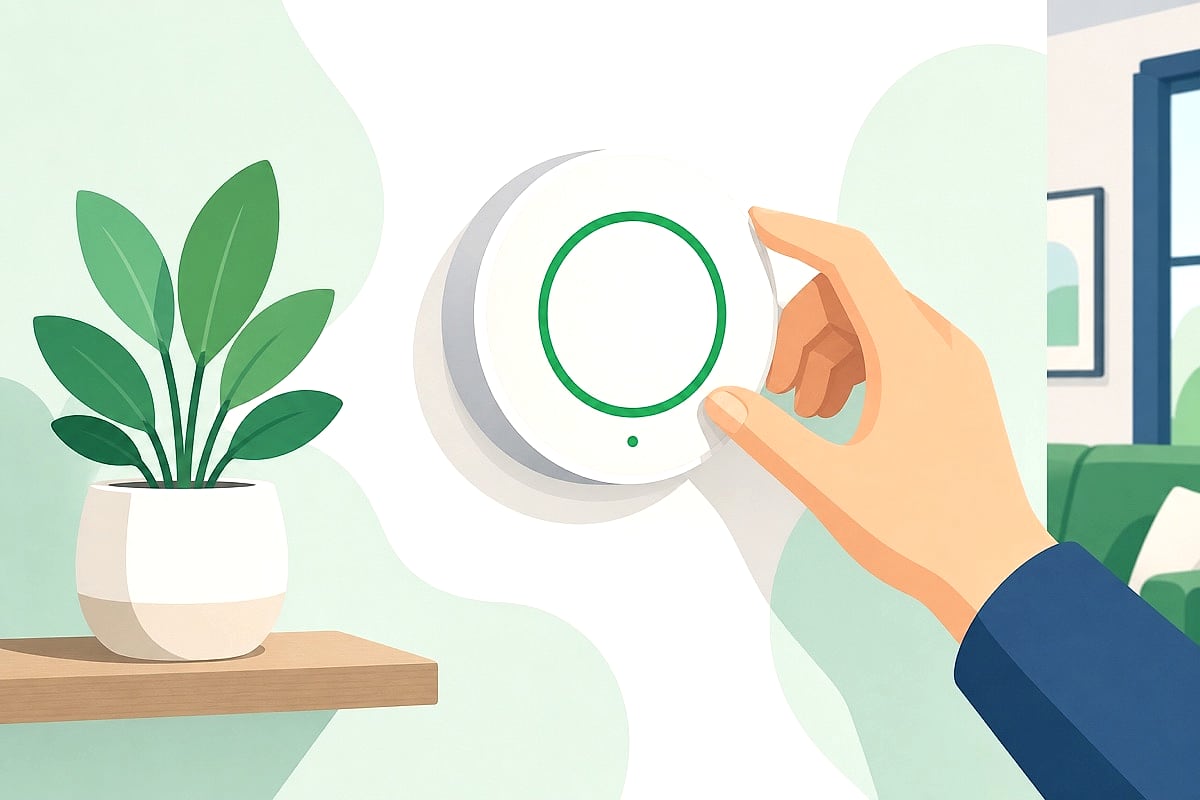
Your thermostat is the control panel for your whole comfort system, and a few settings most people never touch make the biggest difference: the fan AUTO vs. ON choice, sensible temperature setbacks, and — if you have a heat pump — understanding auxiliary heat. Get those right and a basic thermostat will keep a North Bay home comfortable and efficient. Here’s what each setting does and how we set them up.
Programmable vs. smart thermostats
For our mild climate, either type works well; the difference is how much thinking you want to delegate.
| Type | What it does | Best for |
|---|---|---|
| Manual / non-programmable | Holds one temperature until you change it | Simple needs, predictable schedules you set by hand |
| Programmable | Follows a daily/weekly schedule you enter | Routines that don’t change much week to week |
| Smart (Wi-Fi) | Learns patterns, adjusts remotely, reports usage | Variable schedules, remote control, energy tracking |
A smart thermostat earns its keep mainly through better scheduling and remote adjustment — handy when an afternoon turns hot in inland Napa but the coast stays cool. It is not a substitute for a right-sized, well-maintained system; the equipment does the work, the thermostat just tells it when. If you’re after bigger savings, our efficiency upgrades that pay off guide ranks where the real returns are.
Fan: AUTO vs. ON (the setting that confuses everyone)
This single switch causes more “my system feels broken” calls than almost anything else:
- AUTO — the blower runs only when the system is actively heating or cooling. This is the right setting for most homes most of the time.
- ON — the blower runs continuously, even when no heating or cooling is happening, so you feel room-temperature air between cycles. People often mistake that for a furnace blowing cold air or an AC blowing warm air. (In fact, it’s the first thing we check in why a furnace blows cold air.)
There’s a legitimate reason to use ON: continuous circulation through a good filter or air cleaner can help during wildfire-smoke season, when keeping indoor air moving across filtration matters. The trade-off is a bit more energy use and that “neutral air” sensation. Our advice for North Bay homes — run AUTO normally, and switch to ON deliberately during heavy smoke days, then switch back.
Setbacks: small changes, real savings
A setback is simply lowering the heat (or raising the cooling setpoint) while you’re asleep or away, then returning to comfort before you need it. In a mild climate, modest, consistent setbacks add up over a season without making the home uncomfortable.
A few practical rules:
- Don’t crank it. Huge swings make the system work hard to recover and can wipe out the savings — especially with a heat pump.
- Use scheduling. Let a programmable or smart thermostat ease the setpoint back before you wake or get home.
- Heat pumps prefer gentle, gradual changes. Big jumps can trigger backup heat (more on that next).
Heat pumps and “aux heat”
If you have a heat pump, you’ll see an auxiliary heat (often “aux” or “emergency” heat) indicator. Here’s what it means in plain terms:
- The heat pump is the efficient primary heat source — see how a heat pump works for the why.
- Auxiliary heat is backup — electric strips in an all-electric system, or the gas furnace in a dual-fuel heating setup — that helps only when the heat pump needs a hand.
- “Aux on” briefly during a cold morning or after a big setback is normal. Aux running constantly is not — it usually means a setpoint jump that’s too aggressive, a control set up wrong, or a system issue worth a look.
The common mistake is “turbo-charging” a cold house by jumping the thermostat up 8–10 degrees, which kicks on expensive backup heat. With a heat pump, steady wins.
A quick intro to zoning
Zoning divides a home into areas with their own thermostats and motorized dampers, so you can heat or cool the rooms you’re using instead of the whole house. It’s especially useful in North Bay homes with a sunny west-facing side, a converted attic or bonus room, or a multi-level layout where upstairs runs warm. Zoning isn’t a setting you flip on an existing thermostat — it’s a system design — but it’s worth knowing exists if some rooms are never comfortable.
What we see in North Bay homes
Two things come up constantly on our service calls. First, the fan-ON mystery: a homeowner set the fan to ON during smoke season, forgot, and now thinks the heat or AC is failing because the air feels neutral. Second, the missing C-wire: many older Sonoma and Marin homes were wired before smart thermostats existed, and a Wi-Fi stat needs a common wire for steady power. We handle that during installation, but it’s the reason a DIY smart-thermostat swap sometimes won’t power on or keeps dropping offline in an older home.
We also see folks with a perfectly good system who simply never programmed it. A 15-minute setup — a sensible schedule, fan on AUTO, gentle setbacks — often improves both comfort and bills more than any gadget.
Your next step
If your air feels “off,” check the fan setting first — AUTO solves a lot. If you’re upgrading to a smart thermostat in an older home, ask about the C-wire before you buy. And if some rooms are never comfortable, that’s a system conversation, not a thermostat one. Explore our heating and cooling services or contact our Rohnert Park team and we’ll make sure the controls match the equipment.
Frequently asked questions
Should I leave my thermostat fan on AUTO or ON?
For most homes, most of the time, AUTO is the right choice — the blower runs only when the system is actually heating or cooling, which saves energy and avoids the “neutral air” feeling. The main reason to use ON is during heavy wildfire-smoke days, when continuous circulation through a good filter helps clean indoor air. Our suggestion: run AUTO by default and switch to ON deliberately when smoke is bad, then switch back.
Do setbacks really save energy in a mild climate?
Yes, modest ones do. Lowering the heat (or raising the cooling setpoint) while you sleep or are away reduces runtime, and over a North Bay season that adds up. The key is keeping changes gradual — with a heat pump especially, a big setpoint jump can trigger expensive backup heat on recovery, which eats the savings. Let a schedule ease the temperature back before you need it.
Why does my heat pump’s “aux heat” keep coming on?
A brief “aux on” during a cold morning or right after a large temperature change is normal — the backup is helping the heat pump catch up. Aux heat running constantly is the warning sign. Usual causes are setting the thermostat too aggressively, a control configured incorrectly, or a system that needs service. If you see aux on all the time, it’s worth having us check the setup before your bill reflects it.
Can I install a smart thermostat in my older North Bay home myself?
Sometimes, but the common snag is the C-wire (common wire) that most Wi-Fi thermostats need for steady power. Many older Sonoma and Marin homes were wired before smart thermostats existed and don’t have one, which is why a DIY swap may not power on or keeps dropping offline. If you hit that, don’t improvise the wiring — we can add a proper C-wire or an adapter and confirm compatibility with your specific system.
Reviewed by: Chris Street

Author: Chris Street · Co-Owner & Comfort Specialist
Chris Street brings 32 years of hands-on HVAC experience to every Enviro project. He co-owns Enviro Heating & Air Conditioning with his wife, Lori — a true family business, with five of their children working alongside them. Founded in 2008 and based in Rohnert Park, the NATE-certified, Diamond Certified team (California CSLB #928565) is built on honesty, reliability, and community, delivering energy-efficient comfort and top-tier workmanship across Sonoma, Marin, and Napa Counties.
Published: · Last updated: